

To learn how to hire an interior designer, start with a clear project brief and a complete budget. Compare professionals with relevant experience, then check their deliverables, fees, references, and purchasing responsibilities. Before paying, agree on the scope, approvals, and payment terms in writing. This guide helps US homeowners choose the right level of help, from a focused consultation to a full-service project.
1. Define Your Project Before Contacting Designers
Before searching for designers, write a short description of the problem you want to solve. “Make my home look better” is a starting point, but it does not give a professional enough information to recommend services or estimate fees.
A useful project brief explains:
- Rooms or areas that need attention.
- What currently feels uncomfortable or impractical.
- Which furniture and finishes you want to keep.
- Any construction work involved.
- Your overall spending limit.
- Your preferred completion date.
- How much work you want to manage yourself.
For example, a living room brief might say:
“We need seating for five, better evening lighting, and a clear walkway to the backyard. We want to keep our sofa and avoid construction. We can manage purchases, but we need help with the layout and selections.”
That description helps a designer assess whether you need a consultation, a room design package, or more extensive support.
Begin with function before choosing decorative details. Our space planning interior design guide explains how measurements, furniture placement, and circulation affect a room.
2. Choose the Right Type of Design Help
Interior design services vary considerably. One professional may specialize in furniture and styling, while another develops detailed interior plans and coordinates with a renovation team.
Therefore, ask what the individual actually provides instead of relying only on their job title.
Decorating and Styling
Decorating support may suit a room that already functions well but needs help with colors, furniture, window treatments, accessories, or arrangement.
For example, you may need guidance choosing a rug size, combining existing furniture, or creating a consistent palette across connected rooms.
Interior Design
A designer’s scope may include layouts, finish selections, lighting concepts, cabinetry details, furniture specifications, and coordination with other professionals. The exact services depend on their experience, qualifications, agreement, and local requirements.
Architecture, Engineering, and Construction
A design appointment does not automatically cover structural assessment, engineering, permits, or construction. If your project includes removing walls or changing building systems, establish which qualified professionals must handle those tasks.
Professional title and practice rules differ by jurisdiction. Verify relevant credentials and requirements where the property is located rather than assuming one designation carries the same authority everywhere. CIDQ explains these regulatory differences.
3. Understand Common Interior Design Services
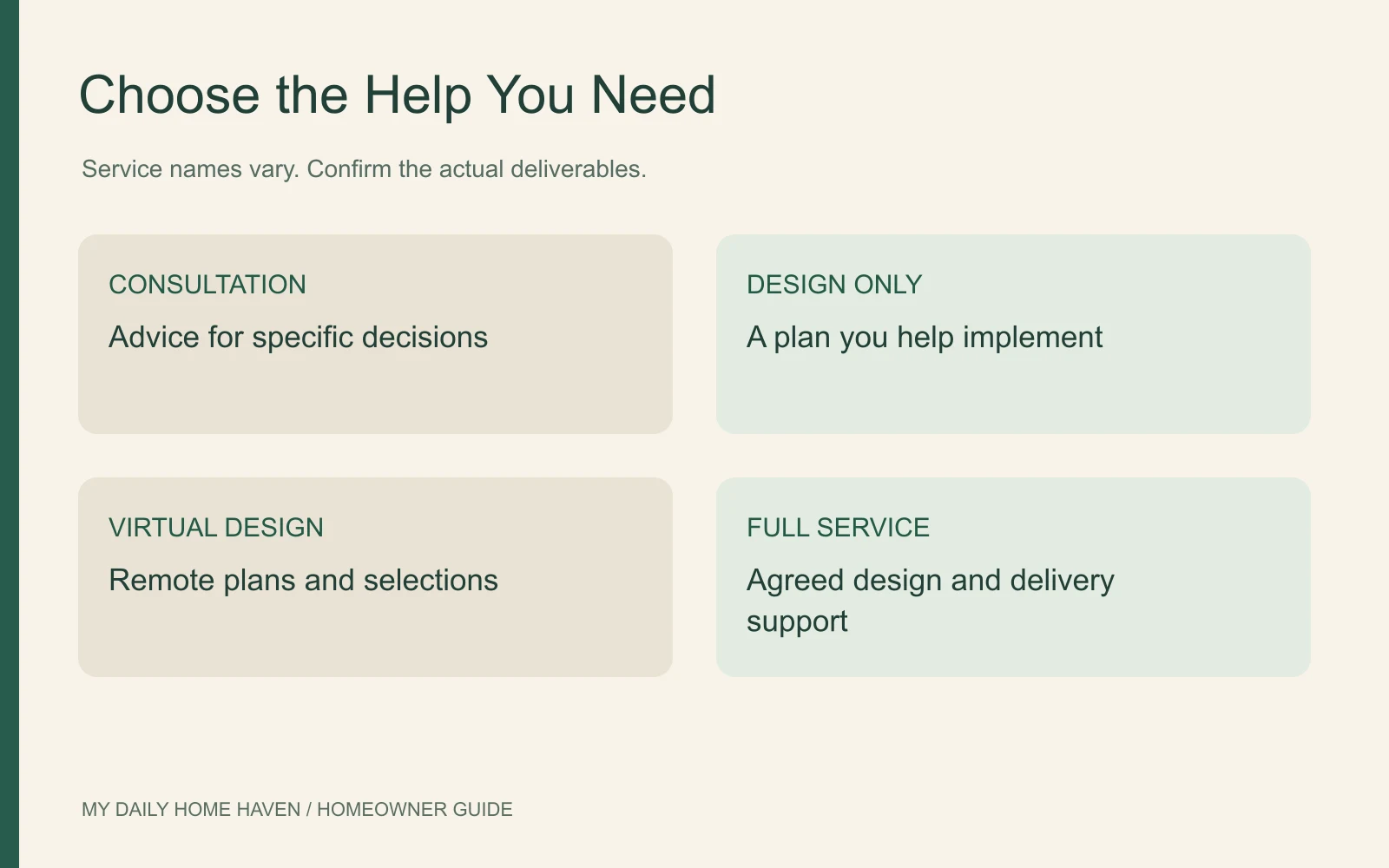
Choose a service based on the decisions you need help making and the work you can realistically handle.
| Service | What it may include | What to confirm |
|---|---|---|
| Design consultation | Advice, priorities, layout discussion, or finish feedback | Whether written recommendations follow |
| Virtual design | Remote layouts, concepts, selections, and shopping guidance | Who measures and verifies product fit |
| Design-only package | A defined plan and specified deliverables | Whether purchasing and installation are excluded |
| Furnishing service | Furniture, rugs, lighting, window treatments, and accessories | Ordering, delivery, and returns responsibilities |
| Full-service design | Design development plus agreed coordination and implementation support | Exactly which stages and tasks are included |
| Renovation design | Interior plans, materials, fixtures, and coordination | Construction documents, permits, and contractor roles |
These are comparison categories, not standardized industry packages. Two firms can use the same service name while offering very different deliverables.
Consultation-Only Help
A consultation can suit homeowners who want professional direction before completing the work themselves. Prepare questions and photographs in advance so the meeting focuses on useful decisions.
Before booking, confirm whether the appointment includes a written summary, drawings, product suggestions, or only verbal advice.
Virtual Interior Design
Virtual services can work well when you are comfortable sharing measurements, photographs, and feedback remotely. They may also suit projects where you intend to handle ordering and installation.
Ask how measurements are checked, what happens when a recommended item becomes unavailable, and whether the designer supports implementation after delivering the plan.
Full-Service Interior Design
Full-service support may suit homeowners who want help managing selections, orders, and installation alongside the design itself.
However, the phrase does not guarantee that every task is included. Ask the firm to define its responsibilities in writing, especially around contractor coordination, site visits, deliveries, and problem resolution.
4. Set a Complete Project Budget
Your designer’s fee is only one part of the total cost. A complete budget should account for the work and purchases needed to turn the design into a usable space.
Separate your budget into clear categories:
- Design fees.
- Furniture and accessories.
- Fixtures and finish materials.
- Construction and installation labor.
- Shipping, receiving, storage, and delivery.
- Applicable taxes and other charges.
- A contingency for uncertainty.
For example, a furniture allowance may look comfortable until you add window treatments, delivery, and installation. A renovation can also reveal conditions that were not visible during the first consultation.
Tell prospective designers your overall limit and explain what it must cover. Ask whether their usual project budgets align with that amount before paying for an extensive proposal.
If the budget and desired scope do not match, reduce the number of rooms, simplify the selections, or divide the project into phases.
5. Understand How Interior Designers Charge
There is no universal interior designer fee. Location, experience, complexity, service level, and purchasing arrangements all affect the quote. ASID’s Minnesota chapter describes several compensation methods and notes that designers may combine them. See ASID’s explanation of costs and fees.
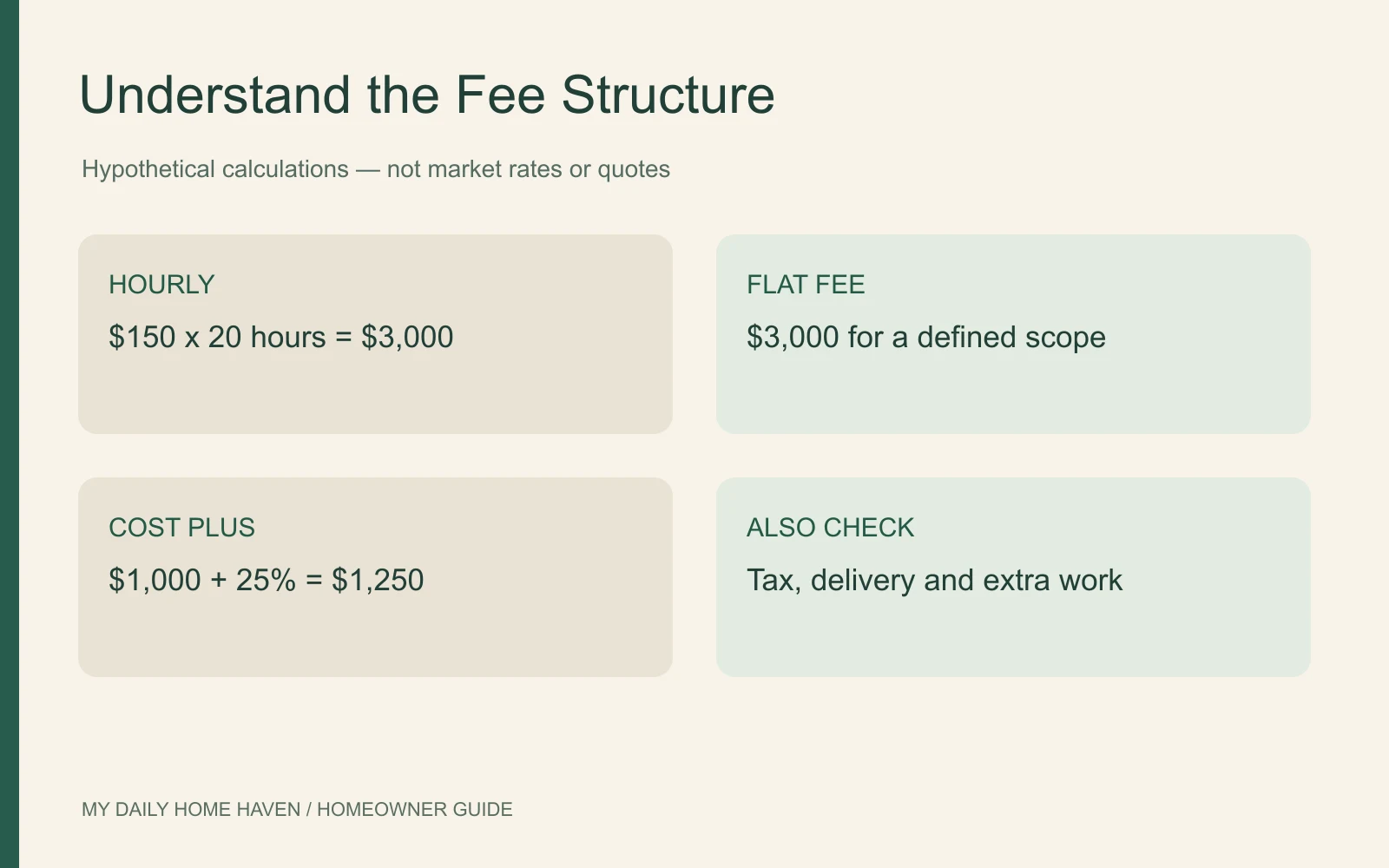
The following examples explain how billing works. The numbers are hypothetical calculations, not market averages or quotations.
Hourly Fees
Under an hourly arrangement, you pay for time spent on agreed tasks.
If a hypothetical designer charges $150 per hour and completes 20 billable hours, the design fee would be $3,000 before other charges.
Ask which activities count as billable time. These might include meetings, sourcing, drawings, travel, site visits, and communication.
Next, request an estimated range of hours, a reporting schedule, and an approval process for work that exceeds the estimate.
Flat Fees
A flat fee assigns a price to a defined scope.
For example, a hypothetical $3,000 room package might include a measured layout, a concept presentation, a selection list, and two revision rounds.
The fee becomes difficult to compare if the deliverables are unclear. Ask what happens when you add another room, change an approved direction, or request more revisions.
Cost-Plus Purchasing
Under a cost-plus arrangement, the designer adds an agreed amount or percentage to the purchasing cost.
If an item costs the designer $1,000 and the agreed markup is 25%, the selling price would be $1,250 before other applicable charges.
Also, confirm the pricing basis, what services the markup covers, and whether delivery or installation is charged separately.
Percentage-Based and Combined Fees
Some agreements calculate compensation using a defined project cost. Others combine a fixed design fee with hourly coordination or product purchasing charges.
Similarly, ask which expenses form the percentage calculation and how later budget changes affect the fee.
Whatever the structure, request a worked example using your project assumptions. A clear example can reveal costs that are difficult to spot in a short proposal.
6. Compare Interior Design Packages by Deliverables
Package names such as “essential,” “premium,” or “complete” do not tell you enough to make a decision.
Instead, compare what you receive.
| Package detail | Question to ask |
|---|---|
| Rooms covered | Is the price for one room, connected areas, or the whole home? |
| Measurements | Who records and verifies dimensions? |
| Drawings | Are layouts, elevations, or construction details included? |
| Product selections | Are exact items specified or only suggested? |
| Revisions | How many rounds are included, and what counts as a round? |
| Purchasing | Who places orders and approves substitutions? |
| Implementation | Is support available after the plan is delivered? |
| Additional work | What triggers extra fees? |
For example, a lower-priced package may require more time from you. A more expensive package may include services you do not need.
Choose the combination that matches your budget, availability, and confidence in carrying out the plan.
7. Find Designers With Relevant Experience
Start with recommendations and a professional directory such as ASID Design Finder. Use these resources to discover candidates, then check project fit, availability, references, and any claimed credentials yourself. A listing alone is not an endorsement of a particular provider or proof that its services match your project.
Look for experience that resembles your project in more than appearance. A designer who regularly manages large custom homes may have a different process and minimum budget from someone who specializes in compact apartments.
Useful similarities include:
- Property type and room size.
- Renovation or furnishing scope.
- Approximate budget level.
- Existing furniture that must remain.
- Household needs.
- Remote or in-person working arrangements.
Also, ask whether the designer is accepting projects of your size and whether your location falls within their service area.
A clear answer early in the process saves time for both parties.
8. Evaluate Portfolios Beyond Appearance
A portfolio shows selected results, often photographed under carefully arranged conditions. Use it to identify potential fit, then ask how the rooms work in everyday life.
For example, discuss a project that resembles yours:
- What problem did the homeowner bring?
- Which existing items were retained?
- What budget constraints affected the design?
- Who handled purchasing and installation?
- What changed between the initial plan and completion?
Also, look for practical evidence such as appropriate furniture scale, useful storage, comfortable lighting, and clear routes through rooms.
Our principles of interior design guide explains concepts such as balance, proportion, and emphasis that can help you discuss these decisions.
You do not need to know your exact style before hiring someone. Gather a few examples of rooms you like, then explain which features appeal to you. Our interior design aesthetics guide can help you describe those preferences.
9. Questions to Ask Before Hiring an Interior Designer
An interview should establish how you will work together, not simply whether you like the same colors.
Ask each candidate a consistent set of questions:
- Have you completed projects with a similar scope and budget?
- What services would you recommend for this brief?
- Who will be my main contact?
- Which tasks will you handle personally?
- What will I need to manage?
- How are fees calculated and reported?
- How do revisions and approvals work?
- What happens when a product is delayed?
- How do you communicate with contractors?
- Can you provide references from comparable projects?
Notice whether the designer asks thoughtful questions about your routines, priorities, and constraints.
You should also feel comfortable discussing disagreement. A useful working relationship allows you to say that a selection is too expensive, impractical, or inconsistent with your preferences.
Compare proposals on the same scope
Copy this worksheet into your notes and complete it from written proposals. Ask both candidates to quote against the same brief. If one offer excludes a task or uses an allowance where the other gives a firm amount, record the difference before comparing totals.
| Compare the same project scope | Candidate A | Candidate B |
|---|---|---|
| Rooms and deliverables | — | — |
| Design fee and calculation basis | — | — |
| Products, delivery, tax and installation allowances | — | — |
| Included revisions and extra-work rates | — | — |
| Measurement and purchasing responsibilities | — | — |
| Timeline assumptions and decision deadlines | — | — |
| References and credentials checked | — | — |
| Exclusions and questions still unresolved | — | — |
10. Check References and Relevant Credentials
Next, ask for references from clients whose projects resemble yours. A recent furnishing client may provide more relevant information about a room package than someone who completed a major renovation many years ago.
Ask former clients whether:
- The scope and fees were explained clearly.
- Communication was consistent.
- Spending approvals were respected.
- Problems were addressed constructively.
- The completed space worked for their household.
- They would hire the designer again.
Verify professional claims rather than relying on a logo in a portfolio. If a designer claims NCIDQ certification, use CIDQ’s certified-designer directory to look up the credential. Separately, check any applicable state registration or licensing requirements with the relevant regulator. Certification and permission to perform a particular type of work are different questions.
Also ask about insurance appropriate to the work and clarify whether independent contractors are hired by you, the designer, or another business.
A recommendation from a friend is useful, but it should complement your own checks.
11. Review the Written Agreement Before Paying
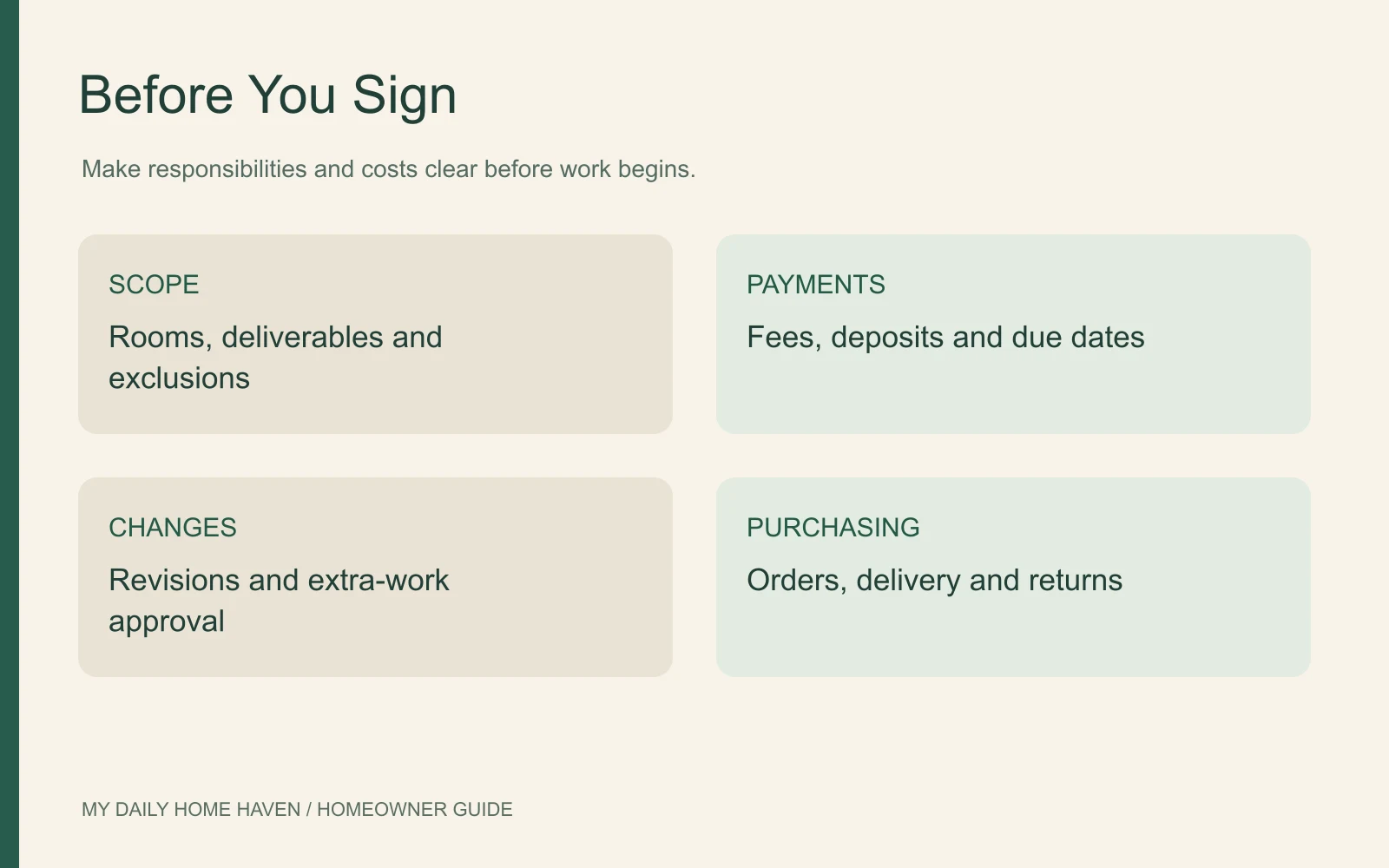
A written agreement should connect your expectations to specific responsibilities, deliverables, and payment terms.
Next, read it alongside the proposal and request clarification wherever the documents differ.
Pay particular attention to:
- Rooms and services included.
- Excluded tasks.
- Design fees and purchasing charges.
- Payment stages.
- Revision allowances.
- Approval procedures.
- Additional-work authorization.
- Purchasing and return policies.
- Timeline assumptions.
- Cancellation and termination terms.
- Rights to use drawings and other deliverables.
- Photography permissions.
ASID offers professional contract resources covering topics such as scope and compensation, reinforcing the importance of documenting the working arrangement. See the ASID Interior Design Contract Package.
Also, ask how any deposit or retainer is applied and whether any portion is refundable. Do not assume that an upfront payment buys a particular amount of design time unless the agreement says so.
For a complex project or terms you do not understand, obtain appropriate independent advice before signing.
12. Clarify Purchasing, Delivery, and Returns
Product purchasing can create responsibilities that are easy to overlook during the design presentation.
Before approving an order, establish:
- Who purchases the item.
- Which business receives payment.
- Who checks dimensions and access.
- Where the item will be delivered.
- The person responsible for inspecting damage.
- The process for handling claims or returns.
- Whether storage charges can apply.
- Whether the item is returnable.
Custom furniture, made-to-order window treatments, and special finishes may have restrictive cancellation terms. Ask for the relevant policy before placing an order.
Also, check delivery access as carefully as room fit. A sofa can suit the layout while failing to pass through a stairwell or doorway.
Finally, keep written records of product approvals, dimensions, finish choices, and substitutions.
13. Agree on a Realistic Timeline
A design project usually depends on more than the designer’s availability. You may also need time for feedback, samples, contractor pricing, manufacturing, shipping, and installation.
Ask for a timeline organized by stages:
- Brief and measurements.
- Initial design direction.
- Design development.
- Product and material approval.
- Ordering or construction coordination.
- Delivery and installation.
- Final review.
Next, identify which dates are targets and which are contractual commitments.
If you have a fixed event or move-in date, explain it before hiring. Ask what can realistically be completed by then and whether temporary alternatives may be necessary.
Finally, make decisions promptly, but avoid approving expensive items before you understand the specifications and terms.
14. Recognize Warning Signs
An attractive portfolio should not outweigh unclear business practices.
Pause if a designer refuses to explain fees, discourages written approvals, or pressures you to commit before providing a clear scope.
Other concerns include:
- A proposal with no defined deliverables.
- Unexplained purchasing charges.
- Claims that credentials cover every type of building work.
- Guaranteed completion dates without acknowledging outside dependencies.
- Repeated avoidance of questions about budget limits.
- Requests for substantial purchases without clear product specifications.
A simple or informal process is not automatically a problem for a small consultation. The documentation should still match the financial commitment and complexity of the work.
15. Get Useful Design Help on a Smaller Budget
If full-service design exceeds your budget, consider narrowing the service.
You could hire a designer to review a layout before buying furniture, develop a plan for one difficult room, or help choose permanent finishes during a renovation.
Other ways to control spending include:
- Keeping suitable furniture.
- Completing one room at a time.
- Preparing measurements and questions in advance.
- Choosing a clear revision allowance.
- Managing agreed purchasing tasks yourself.
- Avoiding late changes to approved decisions.
Discuss reuse at the start. A designer should know which pieces matter to you and which can be repaired, recovered, or repositioned. Our sustainable interior design guide explores practical ways to make considered choices.
The goal is to pay for help where it improves your decisions most.
Frequently Asked Questions
Can I hire a designer before buying a home?
You can ask a designer whether they offer a consultation to evaluate layout possibilities before purchase. Confirm permission to access the property and the limits of the advice. Early design ideas do not replace a home inspection, verified measurements, or assessments by the appropriate building professionals.
What if I dislike the first design proposal?
Explain which parts conflict with the approved brief, budget, or practical needs, and submit one consolidated response. Ask whether the requested changes fall within the revision allowance before work continues. If your preferences or scope have changed, agree on any additional fee and timing first.
What if I need to pause the project or change designers?
Review the agreement’s pause or termination terms and request a written status report covering completed work, outstanding fees, orders, and deliverables. Before another designer takes over, clarify your rights to use existing plans and who remains responsible for purchases. Seek appropriate independent advice if the terms or obligations are unclear.
How to Hire an Interior Designer: Final Checklist
Before committing, confirm that you can answer these questions:
- Does the designer understand the problem I want to solve?
- Does their experience match my project?
- Is my overall budget realistic for their service?
- Do I understand what the fee includes?
- Are purchasing and delivery responsibilities clear?
- Are revisions and additional charges explained?
- Have I checked relevant references and credentials?
- Does the written agreement reflect our discussions?
Hiring an interior designer becomes easier when you compare scope, responsibilities, and communication alongside style. Start with a clear brief, select the level of help you need, and approve work only when you understand the deliverables and costs. That preparation gives both you and the designer a stronger foundation for creating a home that works for your life.