
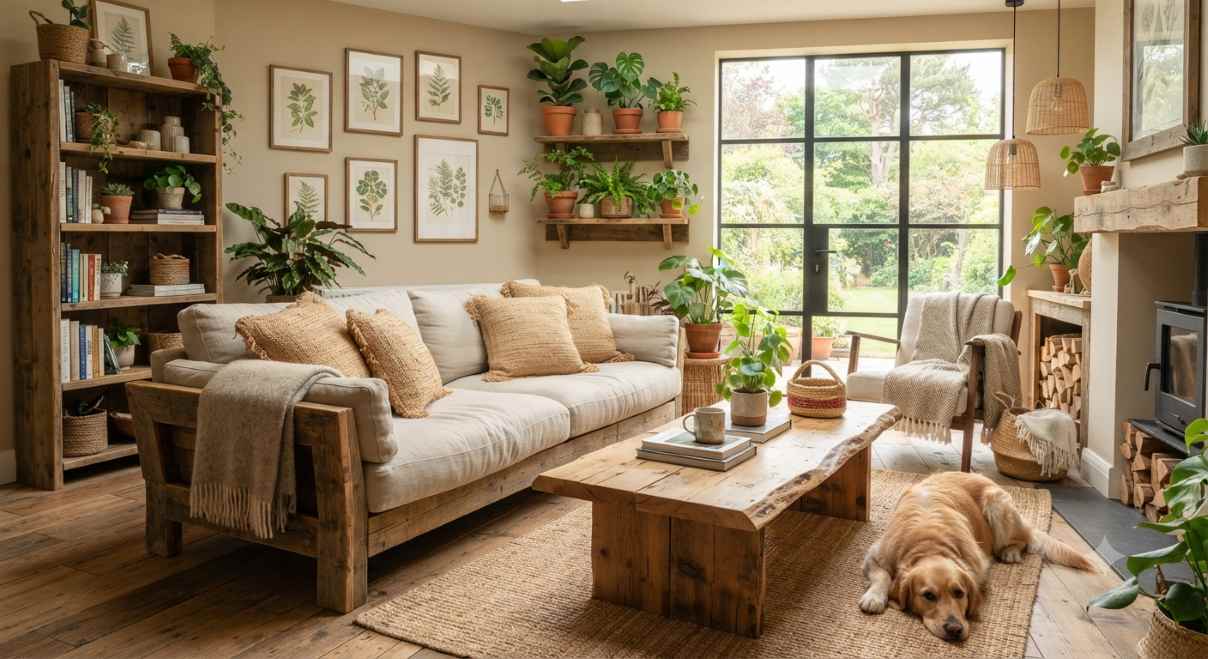

Sustainable interior design means making a room useful and attractive while considering the resources, waste, energy, and upkeep involved in its choices. It starts before shopping. Keeping a suitable table, repairing a chair, or planning a room more carefully can matter as much as choosing a new material with an environmental label.
No single product makes an entire room sustainable. Compare the whole decision: what you need, what you already have, how long something can serve you, and what happens when it no longer does. This guide offers a practical framework for homeowners and renters without pretending every choice has a simple environmental score.
On this page: Begin with a room audit · Use a keep, repair, reuse, then buy approach · Choose materials by purpose and evidence · Indoor air quality: evaluate claims carefully · Use lighting and daylight thoughtfully · Design for a longer useful life · Compare purchases with a practical decision table · Worked example: updating an existing living room · A phased plan for a realistic budget · Frequently asked questions · Start with what you can keep
Begin with a room audit
List what already works
Record the furniture, lighting, storage, and finishes in the room. Note condition and usefulness separately from appearance. An item can look dated while remaining sound, or look attractive while failing to meet daily needs.
Ask whether you can clean, reposition, repair, or adapt each piece. A table might work in another room. A useful cabinet might need different storage inserts rather than replacement. Keep structural repairs and electrical work within the limits of appropriate professional expertise.
Identify the problem before buying a solution
Write down the actual issue. “We need somewhere for school bags” is more actionable than “the entry looks wrong.” A suitable hook or existing cupboard may solve it without a new storage unit.
Start with layout when the room feels crowded. Our space planning interior design guide explains how to test arrangements and furniture operation. Replacing every piece will not solve a route that crosses the wrong activity zone.
Separate necessary changes from cosmetic wishes
Both can be valid, but knowing the difference makes budgeting clearer. Fix the item that does not function before buying accessories to disguise the problem. Keep a waiting list for optional purchases so you can reconsider them after the layout improves.
Use a keep, repair, reuse, then buy approach
For furnishing decisions, consider a sequence: keep useful items, repair what can sensibly be repaired, find another use or owner, and buy when a clear gap remains. This is a decision tool, not a claim that repair always has a smaller impact in every situation.
The EPA’s waste guidance encourages reducing, reusing, and repairing before relying on recycling. For interiors, the practical lesson is to consider an item’s next useful life before treating it as waste.
Repair with the full cost in view
Compare the repair, transport, replacement parts, and likely remaining usefulness. A sound chair with a loose joint presents a different question from extensively damaged upholstery with structural problems. Ask for an assessment when you cannot judge the condition yourself.
Repair can also preserve an object that matters to you. You do not need to justify every inherited piece through a precise carbon calculation. However, sentimental value should not lead you to ignore a genuine safety or functional problem.
Buy secondhand with a checklist
Measure the room and delivery route before browsing. Inspect joints, drawers, finishes, odors, signs of damage, and any components you cannot easily replace. Confirm the seller’s return arrangements and whether you can inspect the item in person.
Secondhand does not automatically mean suitable. A cheap cabinet that cannot fit through the stairwell is still a poor purchase. Leave enough budget and time for cleaning, transport, or specialist work where needed.
Choose materials by purpose and evidence
“Natural,” “green,” and “eco-friendly” are broad descriptions. They do not tell you everything about sourcing, manufacturing, durability, finishes, or disposal. Ask which specific claim a seller makes and what evidence supports it.
A useful material choice fits the room’s wear, moisture, sunlight, and maintenance conditions. A finish that needs frequent replacement may be less practical than a less fashionable option that performs reliably. Product suitability and environmental evidence need separate checks.
Wood and wood-based products
Consider origin, construction, repair options, finishes, and documented sourcing. Solid wood can offer repair possibilities, but it is not automatically the best choice for every application. Wood-based products also vary considerably in manufacture and intended use.
The Forest Stewardship Council explains its product labels, including FSC 100%, FSC Recycled, and FSC Mix. These describe forest-material sourcing categories. They are not interchangeable claims, and they do not certify every environmental or indoor-air-quality aspect of a finished piece of furniture.
Ask the supplier to identify the actual certified product and provide verifiable information. A general sustainability page or a leaf-shaped logo is not the same as documentation for the item you are buying.
Upholstery and textiles
Think about use before fiber preference. A removable cover may make cleaning and replacement easier. A strong fabric suited to your household can be more useful than a delicate option chosen mainly for its environmental wording.
Ask about care instructions, replacement covers, fabric composition, and the scope of any certification. A label on one textile component may not describe the whole sofa. Avoid assuming that a recycled fiber claim proves durability or recyclability in your local system.
Flooring and surface finishes
Inspect existing flooring before deciding to remove it. Cleaning, repair, or a suitable refinishing process may extend its use. Get appropriate advice where the age or condition of a material creates uncertainty about safe handling.
For new surfaces, compare expected wear, moisture suitability, cleaning needs, installation materials, and repair options. Request real samples. A material’s appearance on a screen cannot show how it feels or how its finish behaves in your room.
Indoor air quality: evaluate claims carefully
Paints, adhesives, furnishings, and other products can release volatile organic compounds. The EPA’s information on VOCs explains sources and ways to reduce exposure, including following product directions and improving ventilation when appropriate.
Do not treat a low-VOC description as a promise that a product has no emissions or is suitable for every person. Ask what the claim measures, which test or standard supports it, and whether it applies to the complete product.
Plan the installation, not only the purchase
Consider adhesives, coatings, curing instructions, and room use during work. Keep product information and follow manufacturer directions. Where a household member has a particular sensitivity or health concern, seek guidance appropriate to that situation rather than relying on decorating advice.
Plants are a design choice, not a substitute for source control
Plants can contribute greenery, texture, and a connection to nature. Choose species and placement according to available light, care capacity, and household needs. Do not use decorative plants as a replacement for ventilation or controlling pollutant sources.
Biophilic design can include daylight, views, patterns, and natural references as well as plants. It is a design approach, not a product certification. A green-looking room still needs the same careful purchasing decisions as any other interior.
Use lighting and daylight thoughtfully
Arrange activities around useful light where possible. A reading corner benefits from a well-positioned task lamp; a home office needs attention to glare. Daylight can help illuminate a room, but privacy, heat, and comfort still matter.
Layer lighting according to use rather than leaving every light on for every activity. Choose compatible, appropriately rated products and controls. Follow fixture instructions, and use a qualified electrician for work that requires one.
The U.S. Department of Energy’s consumer lighting guide explains energy-efficient lighting choices. Use product specifications to compare light output, power, compatibility, and the type of light you need, rather than choosing by appearance alone.
Design for a longer useful life
Favor furniture you can maintain
Ask whether hardware, cushions, covers, or other parts can be replaced. Read care instructions before buying. An appealing material may be inconvenient if it requires a level of maintenance your household cannot sustain.
Keep a simple record of supplier details, finish information, and spare-part references. This can make a later repair easier. Store leftover samples or spare hardware where you can actually find them.
Plan for changing routines
A room may need to accommodate a guest, a new hobby, a changing work schedule, or different mobility needs. Movable seating and flexible storage can help where they suit the household. Multifunctional furniture is useful only if changing its function is realistic in daily life.
Choose a visual direction you enjoy beyond a trend
A coordinated palette can make it easier to keep useful objects through future updates. Our interior design aesthetics guide helps you define that direction. Our principles of interior design show how existing pieces can work together even when they do not match.
Compare purchases with a practical decision table
You may not have a full life-cycle assessment for every item. Be honest about that limit. You can still ask focused questions and avoid unsupported claims about one option being universally better.
| Question | Evidence to request | Why it helps |
|---|---|---|
| Does it solve a defined need? | Dimensions and room plan | Reduces unsuitable purchases |
| Can it last in this room? | Intended use and care instructions | Connects durability to real conditions |
| Can it be repaired? | Parts, covers, hardware, service options | Helps plan ongoing use |
| What does the environmental claim mean? | Named standard and product documentation | Makes the claim specific |
| What arrives with it? | Packaging and delivery information | Helps prepare for waste and access |
| What happens later? | Take-back terms or local options | Avoids assuming everything is recyclable |
Check tradeoffs rather than adding arbitrary points to create a fake sustainability score. A product can perform well on one question and poorly on another. Explain why your final choice suits the actual room and household.
Worked example: updating an existing living room
Imagine a household with a sturdy sofa, a scratched wood table, inadequate toy storage, and lighting that feels harsh at night. They want a calmer room without replacing everything. This is a hypothetical planning example, not a measured environmental case study.
First, they rearrange seating to create a clearer route. Next, they assess whether the table’s finish can be repaired safely and economically. They use an existing cabinet for toys, provided its condition and placement suit the use.
Then they compare lighting options for reading and evening use. Finally, they choose one coordinated textile rather than a full set of new accessories. The result addresses practical problems while retaining useful items; no unsupported savings or emissions figure is needed.
For more room-specific ideas, see our existing zero waste living room guide. It complements this wider material-and-purchasing framework.
A phased plan for a realistic budget
Keep packaging and return requirements in mind when an item arrives. Inspect the product before discarding the materials needed for a return, then check local reuse or collection options. Photograph useful labels and care information for your own records. These small organizational steps can make a later repair or warranty inquiry easier without requiring another purchase or a complicated tracking system.
Start with an audit and no-purchase rearrangement. Then price necessary repair and maintenance. Only after that, compare missing items with their dimensions, care requirements, and supporting product information.
If you use visual planning software, avoid letting its furniture catalog become an automatic shopping list. Our interior design software guide explains how to model existing pieces first. Similarly, read interior design trends news for ideas you can adapt rather than reasons to discard suitable finishes.
Frequently asked questions
Is sustainable interior design always more expensive?
No. Reusing or rearranging suitable items can reduce initial spending. Some documented products or repairs cost more, so compare the whole decision, including care, transport, and likely useful life. Avoid assuming a premium price proves a stronger environmental claim.
Is natural material always the most sustainable option?
No. Origin, processing, use, maintenance, and end-of-life options matter as well. Evaluate the specific product and its application rather than relying on the word “natural.”
Can renters use this approach?
Yes. Focus on furniture arrangement, repairable belongings, removable textiles, and lighting choices allowed by the lease. Ask permission before making permanent changes, and prioritize items that can continue serving you after a move.
Start with what you can keep
Choose one room and identify a useful item you can retain, a problem you can solve through layout, and one purchase you can postpone. Sustainable design becomes more practical when every change has a clear purpose and an honest explanation.
2 thoughts on “Sustainable Interior Design: A Practical Guide to Better Choices”