

Emphasis in interior design gives a room a clear visual priority. A fireplace, view, artwork, or furniture grouping can attract attention, while quieter elements support it. You do not need a dramatic architectural feature to create emphasis. Start by deciding what deserves attention from the positions where people actually enter and sit.
Our principles of interior design guide explains how emphasis works with balance, scale, and unity. This article focuses on choosing a focal point, reducing competition, and testing the result without redesigning the whole room.
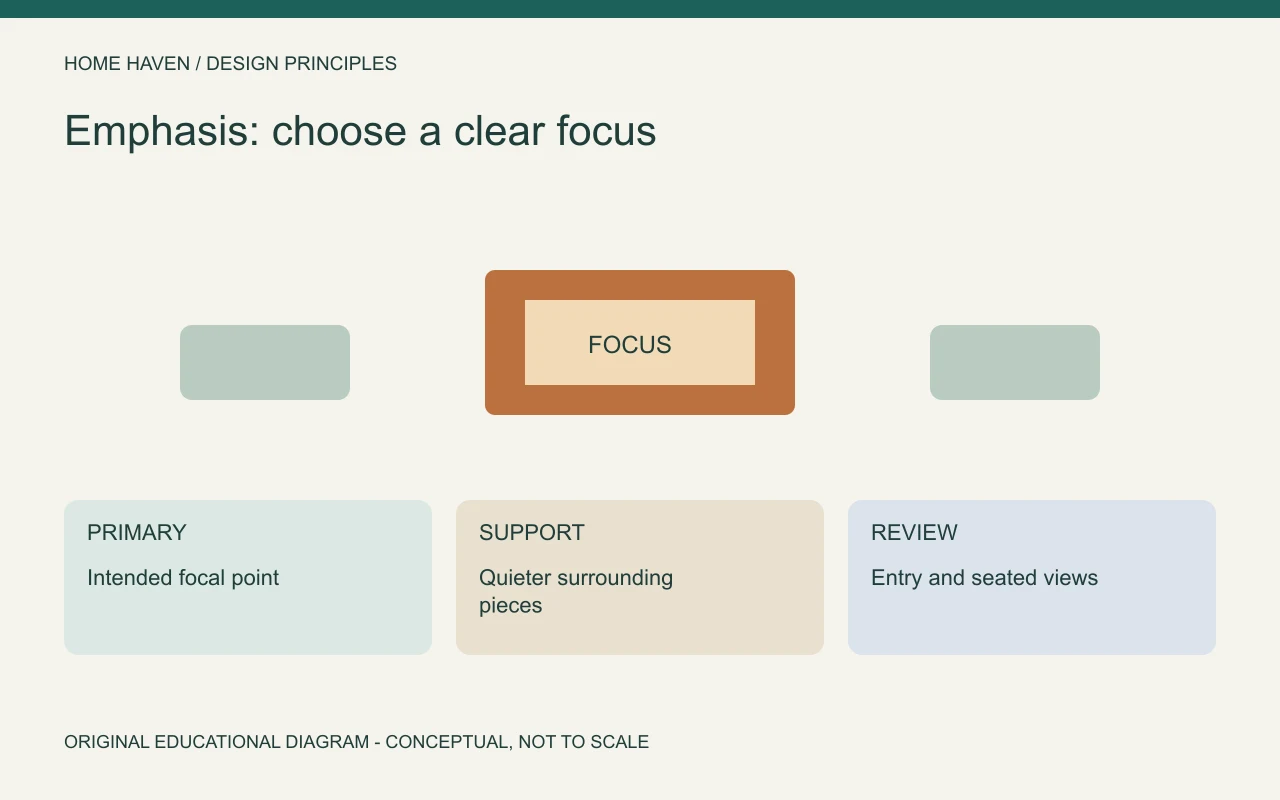
Notice the emphasis the room already has
Stand at the doorway and look at the room before changing anything. What attracts your eye first? It might be a window, a dark cabinet, a television, or an unexpectedly bright storage bin. The strongest visual feature may not be the one you intended.
Repeat the observation from the main seating position. A room can have different priorities from different viewpoints. Write down the first feature you notice in each view, then decide whether it supports the way you want to use the space.
Choose a focal point with a purpose
A focal point should relate to the room rather than exist only to create drama. In a conversation area, the seating group itself can provide the focus. In a reading corner, a chair, lamp, and artwork may form a small composition.
Getty’s formal analysis guide describes emphasis as the part of a composition that attracts attention. The room exercises here apply that broad visual idea to furnishing decisions; they are practical decorating suggestions, not fixed design laws.
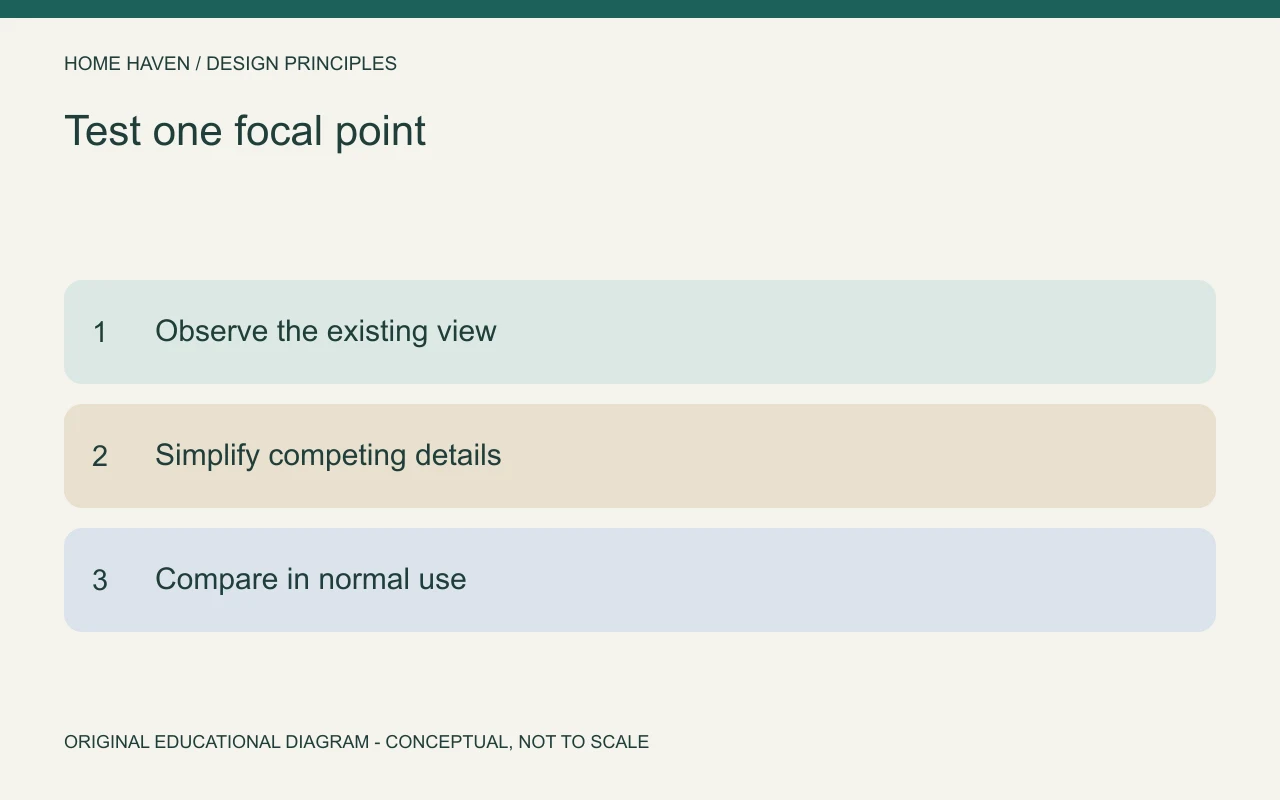
Emphasis in interior design does not require a feature wall
Paint is one option, but placement, shape, size, light, and surrounding space can also create focus. A single artwork on a quiet wall may draw more attention than several highly patterned surfaces competing at once.
Before buying something new, simplify the area around an existing feature. Remove unrelated accessories temporarily and compare the result. The improvement may come from making the background calmer rather than making the focal object larger.
Give supporting objects a quieter role
Choose which items should lead and which should support. A richly colored sofa can work as the main feature when the surrounding finishes are restrained. If every cushion, curtain, lamp, and artwork demands equal attention, the arrangement may feel fragmented.
Quieter does not have to mean plain white. Supporting objects can share a similar tone, repeat a material, or use a less assertive pattern. Keep enough variation for interest while preserving a recognizable visual hierarchy.
- Keep the strongest contrast near the intended focus.
- Reduce unrelated small objects around a major feature.
- Repeat a supporting color in a few useful locations.
- Leave enough visible background to distinguish the main composition.
Relate furniture to the intended focus
Review where seats face and what people see while using them. A focal fireplace is less convincing as the organizing feature if every seat turns away from it. However, the furniture must still serve conversation, comfort, and access.
Use the space planning guide to check the measured arrangement. Do not block a doorway or squeeze a route simply to make the room look centered in a photograph. Visual priorities should work with everyday use.
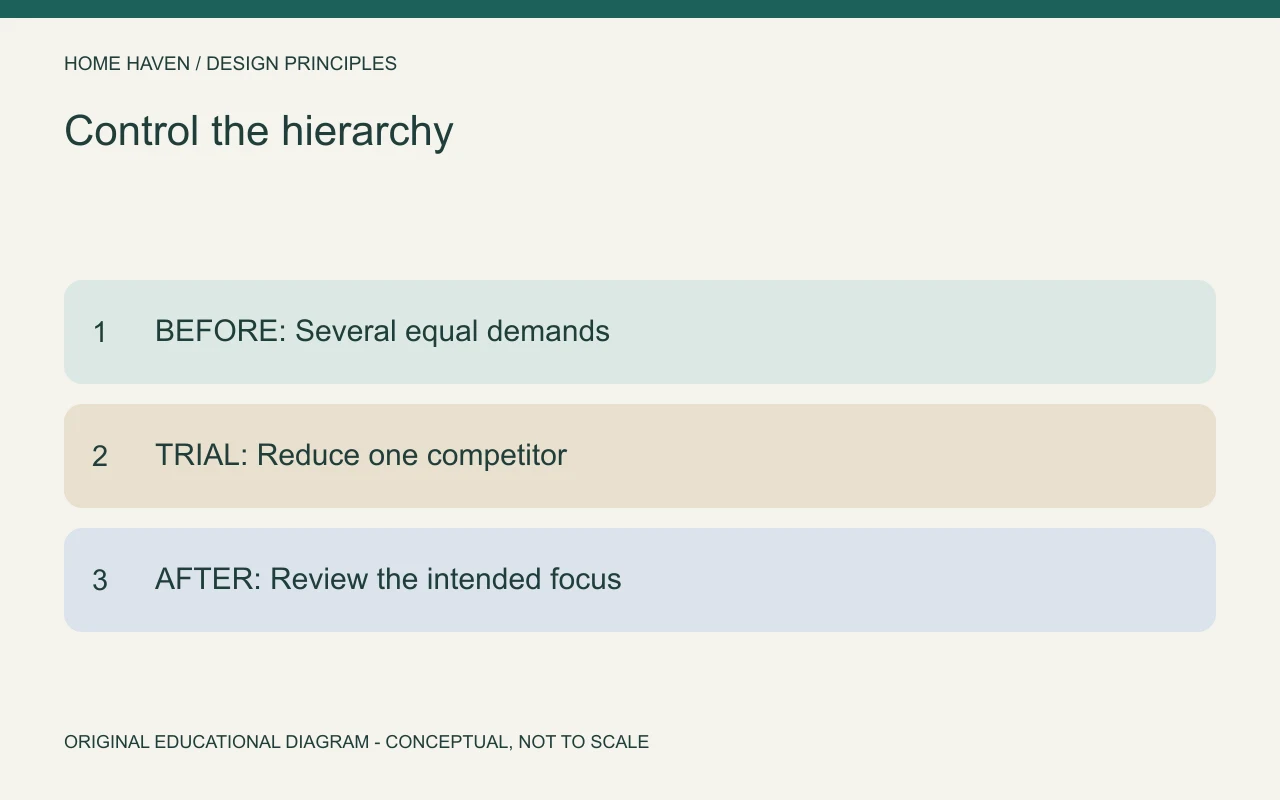
Resolve a television and fireplace competing for attention
Start by identifying which feature matters most during ordinary use. You may use the television frequently while the fireplace remains primarily architectural. That does not mean one must disappear; it means the arrangement needs a deliberate relationship.
Reduce clutter and unnecessary contrast around one feature, or position the seating so both relate to a shared area. Avoid assuming that mounting a television above a fireplace is always suitable. Viewing comfort, product requirements, heat, and installation conditions need separate assessment.
Use lighting to support the focus
An adjustable light can make artwork or a textured surface more visible, but excessive brightness can turn a supporting detail into the main attraction. Compare the room with the usual evening lighting rather than judging only in daylight.
Keep the light source comfortable from seated positions. A bright exposed bulb may attract more attention than the object it illuminates. Test aiming and shielding within the fixture’s intended use, and use appropriate professional help for permanent electrical changes.
A small-room example
Imagine a hypothetical 12-by-14-foot living room with an existing sofa, a low cabinet, and a large window. The household wants a calmer seating area without replacing the furniture. A bright shelf display currently competes with both the window and the television.
First, reduce the display to a few connected objects. Next, group the seating around the activity zone and use one artwork to relate the cabinet to the composition. Review from the entry and the sofa. The goal is a clearer arrangement, not a prescribed number of decorative pieces.

Test emphasis without committing to purchases
Take comparison photographs from the same positions and under similar lighting. Change one major variable at a time, such as removing a display or relocating a lamp. Ask whether the intended feature becomes clearer and whether the room remains useful.
Do not rely only on a tightly cropped photo. Walk through the room and sit in the actual chairs. A composition that looks convincing from one camera angle may hide an awkward relationship from ordinary viewpoints.
Common emphasis mistakes
Common problems include adding a new focal feature before resolving an existing conflict, using strong contrast everywhere, and treating the television as an accidental afterthought. Another mistake is assuming a focal point must sit at the exact center of every wall.
Choose the strongest view deliberately, then let smaller compositions support it. An open-plan room can have several activity areas with their own focus, provided the shared view does not turn every area into an equal visual demand.
Emphasis questions
Can a room have more than one focal point?
Yes. Different views or activity zones can have different priorities. The useful question is whether those priorities read clearly or compete without a reason.
Can an existing object become the focal point?
Yes. Placement, surrounding space, and a quieter background can give an existing artwork or furniture group more presence. A new purchase is not always necessary.
Make one relationship clearer
Choose a view, identify the intended focus, and simplify what competes with it. Recheck comfort and access before making the change permanent. Effective emphasis helps the room communicate its purpose without requiring every object to stand out.