
American interior design is a broad term covering many regional, historical, and contemporary approaches. A New England room, a Southwestern home, a modern apartment, and a midcentury-inspired living area can look very different. The useful question is which references fit your home and the way you live.
Rather than prescribing one national look, this guide helps you choose a direction and connect the pieces. Our interior design aesthetics guide provides more detailed comparisons between particular styles and palettes.
American Interior Design: Start with a Region or Period
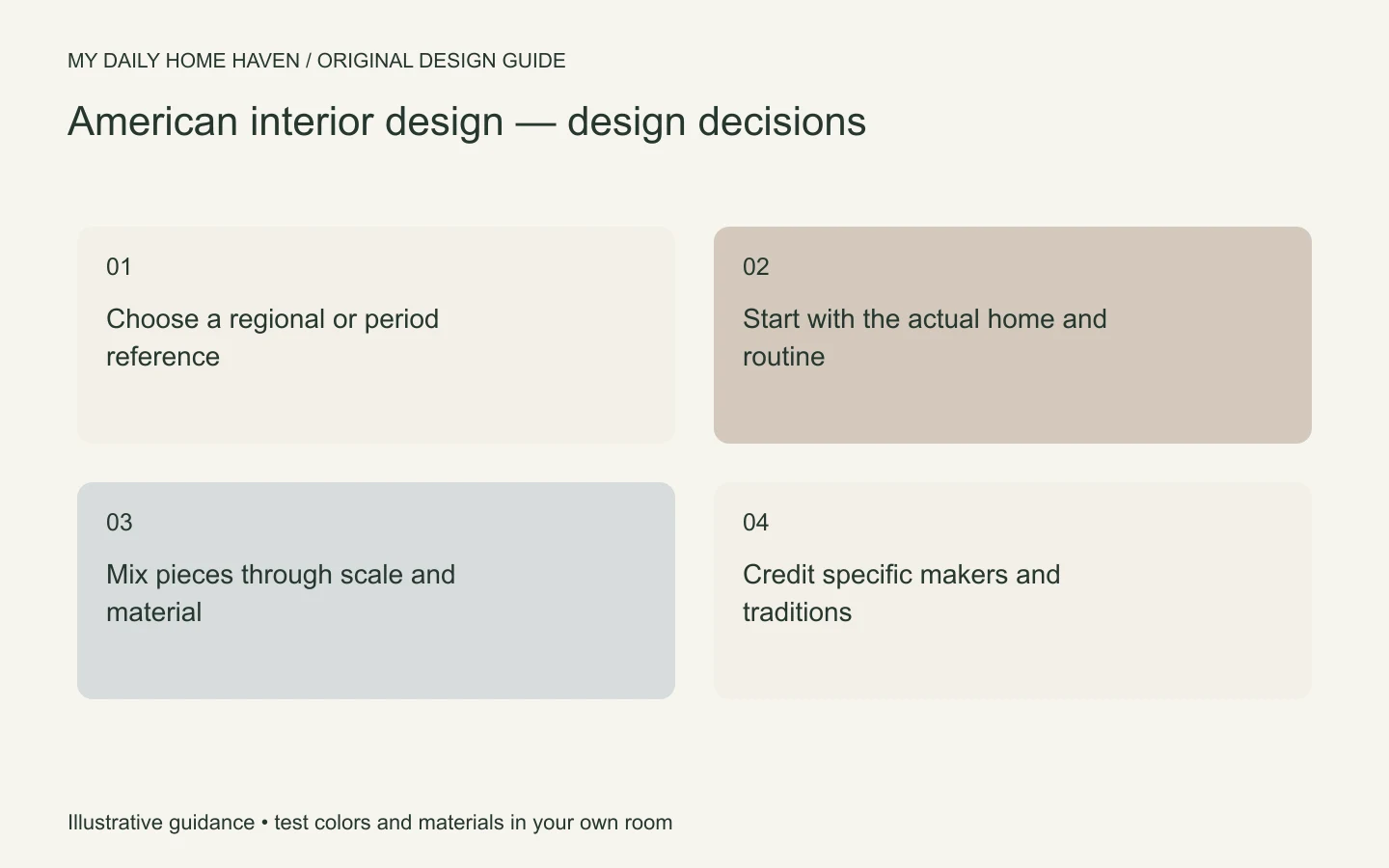
American interior design includes many regional, historical, and contemporary influences. Choose a specific place or period as a reference, then check how its materials and furniture relate to your own architecture and routine. Use documented pieces and local makers where possible; avoid treating one look as representative of every American home.
Start with variety rather than a single formula
Design in the United States reflects varied communities, migration, trade, regional materials, changing technologies, and individual makers. A room should not be described as the American style simply because it contains one familiar furniture form.
The Driehaus Museum’s Art of Seating exhibition presents American chair designs across two centuries. It is a useful example of change within one object category: form, material, and social context do not remain fixed.
When studying a historical room, identify its place, date, and household context. Museums may present specific affluent interiors or reconstructions rather than typical everyday homes. Read the interpretation instead of treating the room as a universal national model.
Choose a direction that suits the building
Look at the existing architecture and fixed finishes. A compact contemporary apartment may benefit from simpler furniture and efficient storage. A house with surviving traditional trim may support a different balance of pattern and furniture forms.
Choose one or two primary references rather than combining every style you like at equal strength. You might prefer tailored traditional furniture with contemporary art, or clean modern forms with warmer regional materials. A clear direction helps you make consistent decisions.
The American Museum and Gardens’ period rooms offer examples with different geographic and historical contexts. Use such resources to learn distinctions, then decide what transfers to a present-day home.
Plan around actual daily life
List the activities the room must support: conversation, television, reading, work, play, or dining. Then identify the furniture and storage needed for those activities. A style label should not determine a layout that is uncomfortable or impractical.
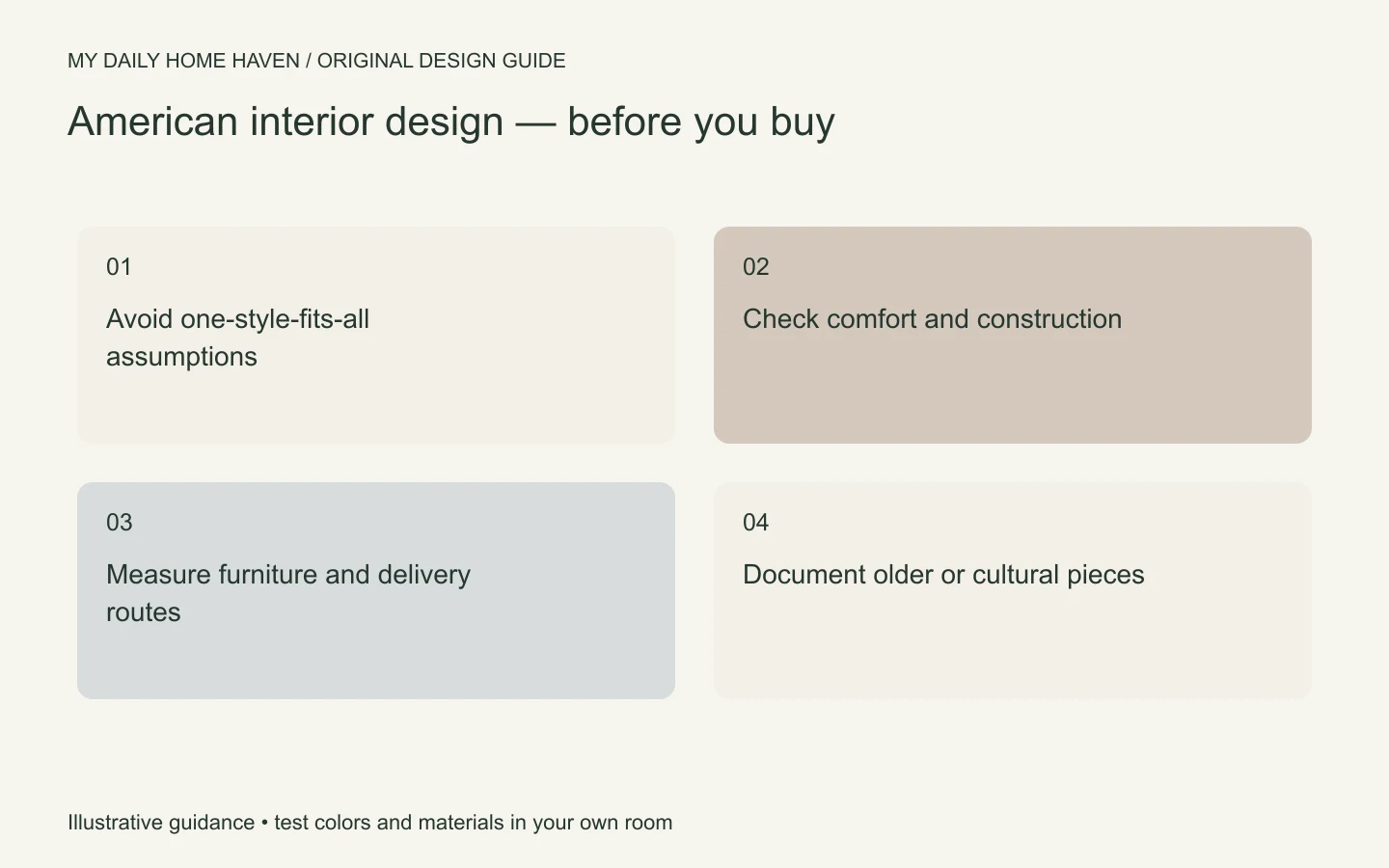
Measure the room and the furniture before buying. Include door swings, delivery routes, and the space needed to open drawers or pull out chairs. A large sofa can look normal in a spacious showroom and consume most of a modest living room.
Our space planning guide helps connect the layout to practical routines. Start there if the main problem is circulation or furniture fit rather than the visual style.
Mix furniture through clear relationships
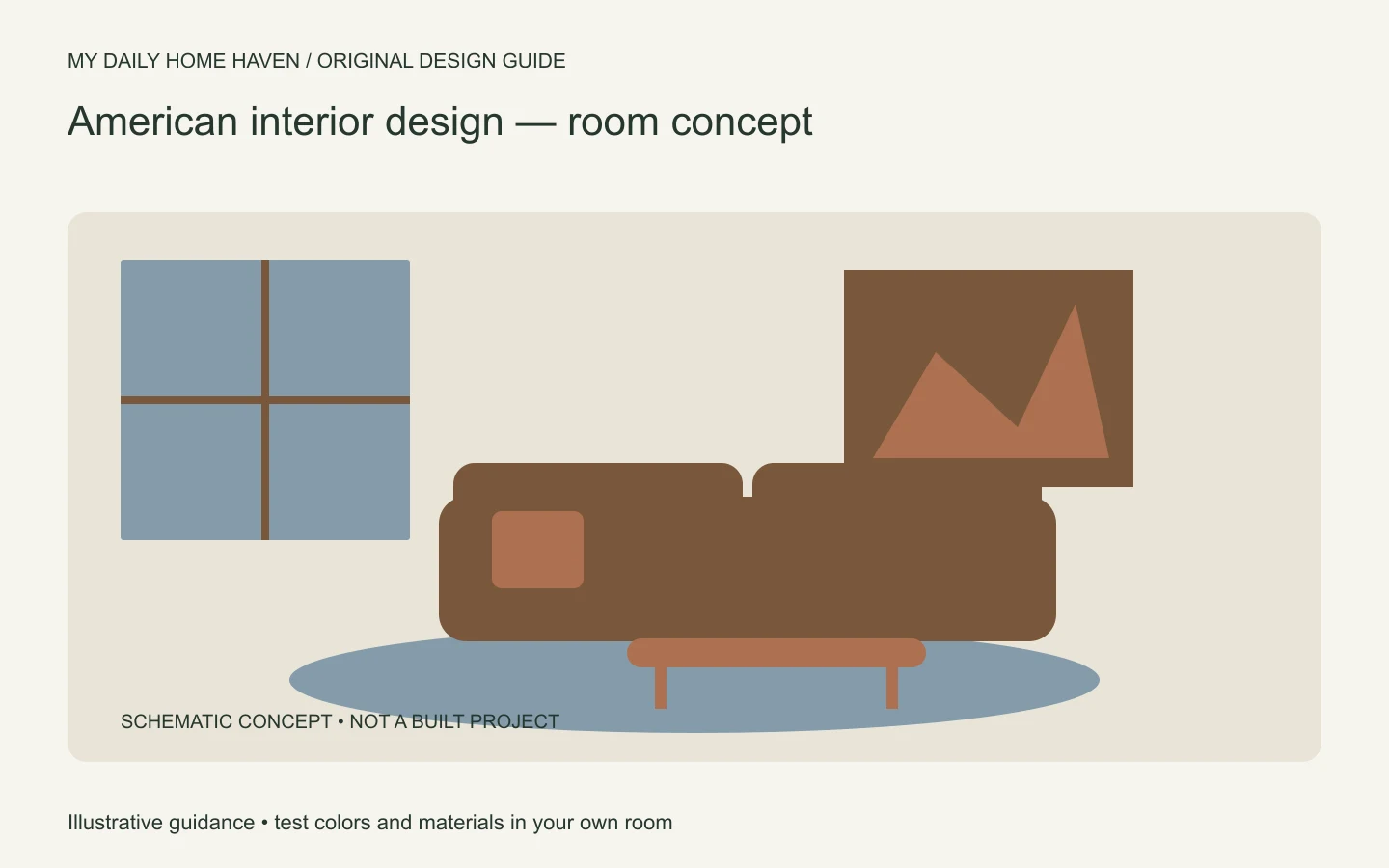
Pieces from different periods can work together when scale, color, or material provides a connection. A traditional wood chest may sit comfortably beside contemporary upholstery. A modern chair can offer contrast in a more decorative room.
You do not need every piece to be made in the same place to create a coherent American home. If domestic manufacture matters to your purchase, verify the seller’s actual manufacturing information. A brand’s headquarters or style description does not establish where an item was made.
Inspect construction and comfort. Check joints, drawers, seat support, fabric care, and replacement parts where relevant. For older furniture, ask about condition and repairs rather than assuming age proves quality.
Build a palette from what stays
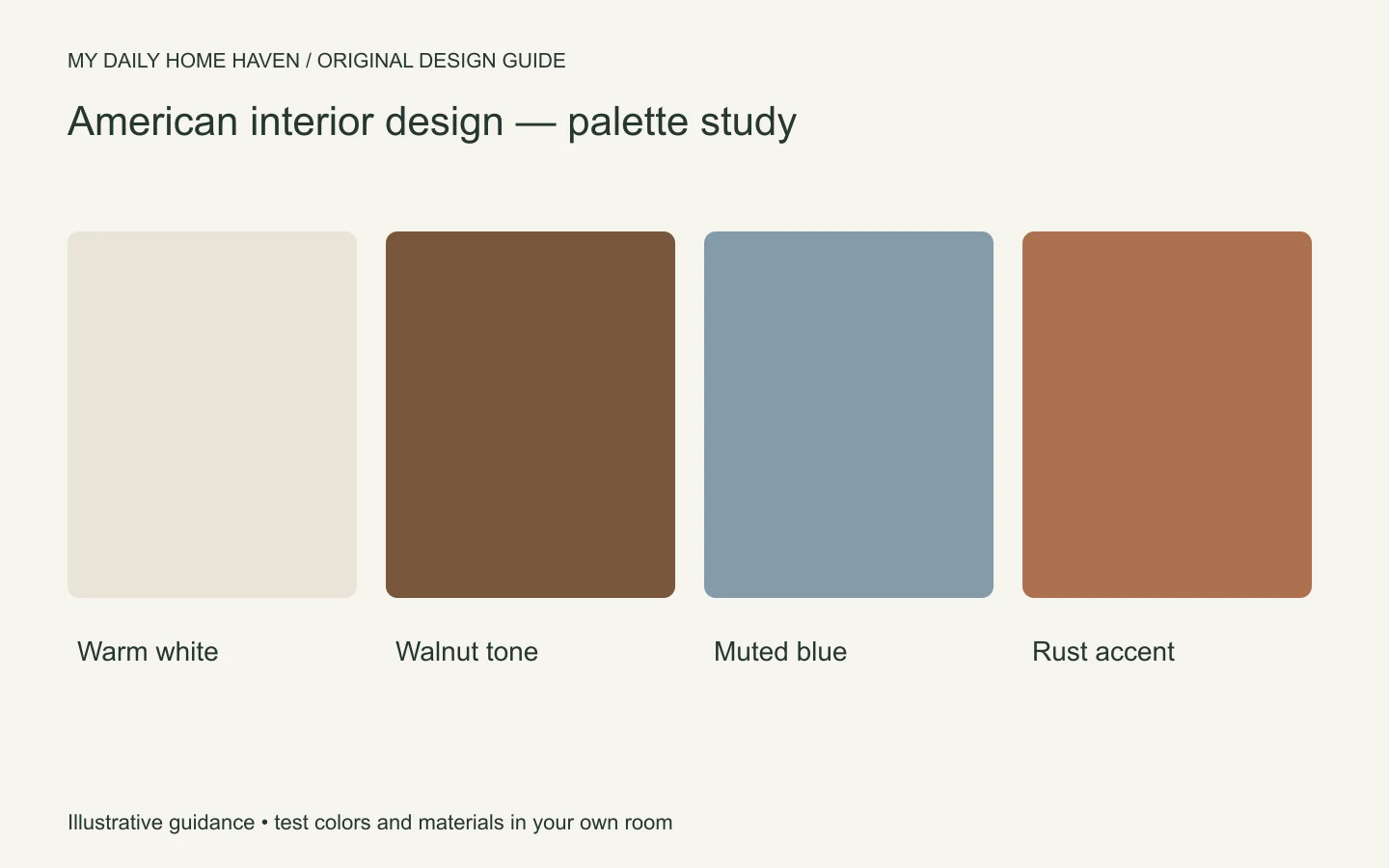
Start with the floor, cabinetry, stone, and main upholstery. Compare new paint and fabric samples beside them. Choose enough contrast to distinguish adjacent surfaces without introducing an unrelated color on every item.
A restrained palette can support a mix of furniture forms. Alternatively, a stronger color scheme can work when the larger pieces remain simpler. The balance depends on what you want to emphasize and how much visual activity you enjoy.
Avoid assuming that red, white, and blue are necessary national design signals. Regional references, personal collections, and material choices can be more useful than literal symbolism. Choose colors because they work in the room and suit the people using it.
Use regional and cultural references accurately
If you admire a particular craft or tradition, learn its name and seek reliable information about the maker and intended use. Do not treat Indigenous, immigrant, or regional work as an interchangeable category of ethnic accessories.
Keep attribution with the piece and describe uncertainty honestly. A seller’s broad label may not establish origin, age, or authenticity. When a claim matters to the purchase, ask for documentation or choose a better-supported alternative.
Contemporary work belongs in the story too. A home can combine new design with inherited or historical pieces without making the older references less meaningful. The aim is an honest, useful mix rather than a frozen period display.
A practical starting sequence
First, keep the best existing pieces and solve the largest layout problem. Next, choose a palette around the permanent finishes. Then add one or two pieces that bring the direction you want, such as a useful older chest or a more expressive artwork.
Use the room before adding the final accessories. Notice where light, storage, or a table is missing. Buying for those gaps usually creates a more comfortable result than purchasing a complete style package in one order.
Write a direction statement
Before shopping for American interior design, write a short statement that names your actual priorities. For example, a practical family room with simple contemporary seating, warm timber, and a small collection of older pieces gives more direction than the national label alone. Include what you will keep and the main problem to solve. Use the statement when comparing products so a tempting purchase does not pull the project into an unrelated theme. You can revise it as your understanding improves, but keep the reason for each change clear. Specific priorities make a broad field of choices easier to navigate.
Frequently asked questions
Is American style the same as farmhouse?
No. Farmhouse is one broad reference among many. Urban, regional, modern, traditional, and historically specific approaches all contribute to the larger picture.
Can I combine regional influences?
Yes. Give the room a clear main direction and connect pieces through scale, palette, or material. Describe the individual references rather than presenting the mix as one uniform tradition.
Does the furniture have to be made in the USA?
No. Style and manufacturing origin are separate questions. If domestic production is a priority, verify the product’s specific information before purchasing.
\n\n