

Stepping Into a More Sustainable American Lifestyle

Let us be honest about something important. Zero waste living in the United States does not require perfection, homesteading, or eliminating trash overnight. Instead, it starts with intentional decisions that reduce what we send to landfills while improving our daily lives.
Here is a reality check. Americans generate nearly 5 pounds of municipal solid waste per person per day, according to the Environmental Protection Agency. That adds up to roughly 1,800 pounds per person annually. Much of that waste is recyclable or compostable—yet it still ends up buried or burned.
However, here is the encouraging truth. Zero waste is not about guilt. It is about redesigning habits. When you reduce disposable purchases, you often save money, simplify your home, and gain clarity about what truly adds value to your life.
The journey begins with one small swap:
- A reusable grocery bag
- A stainless steel water bottle
- Saying no to plastic cutlery
Small shifts compound over time. Consequently, your impact grows far beyond what you might imagine.
For foundational knowledge, explore our comprehensive Zero Waste Living Definition (2026 to 2027): Complete Beginner’s Guide to a Waste-Free Life before diving deeper.
Understanding Zero Waste in the U.S. Context
From Linear to Circular
The traditional U.S. economy follows a “take–make–dispose” model. Raw materials are extracted, turned into products, and discarded after brief use.
Zero waste aligns instead with a circular economy—a system designed to keep materials in use for as long as possible through reuse, repair, composting, and responsible recycling.
Federal agencies like the Environmental Protection Agency now promote waste reduction and material recovery strategies nationwide. Meanwhile, the Natural Resources Defense Council continues to report on plastic pollution’s impact on more than 700 marine species.
In 2026–2027, sustainability in the U.S. is increasingly shaped by:
- Extended Producer Responsibility (EPR) laws in states like California and Maine
- Right to Repair legislation expanding across multiple states
- Corporate transparency initiatives requiring companies to disclose environmental impact
- Growth in refill and reuse systems at major retailers
These shifts make zero waste living more accessible than ever for American households.
The Modern 5 R’s Framework (2027 Priority Order)
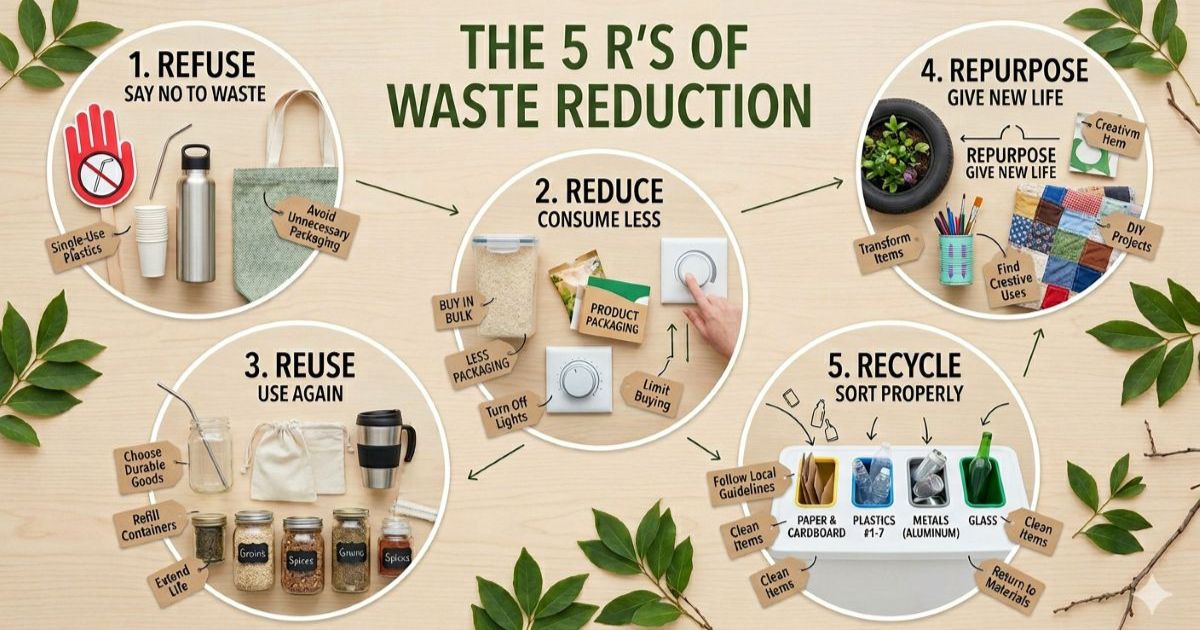
Recycling alone is not enough. In fact, it is the last resort in a truly sustainable system.
Follow the 5 R’s in this exact order:
| R | Action | U.S.-Based Example |
| Refuse | Say no to what you don’t need | Decline plastic utensils with takeout orders |
| Reduce | Buy less and choose quality | Use the 30-day purchase rule for non-essentials |
| Reuse | Invest in durable, long-lasting goods | Mason jars, stainless steel containers, cloth bags |
| Rot | Compost organic materials | Backyard bins or city green waste programs |
| Recycle | Properly sort what remains | Follow your local state recycling guidelines |
Many American households report saving between $500–1,200 annually by cutting disposable products and impulse purchases. That is real money staying in your pocket.
Practical Zero Waste Swaps for American Homes
Transition room by room to avoid feeling overwhelmed. This approach builds momentum without burnout.
The Kitchen – America’s Largest Waste Source
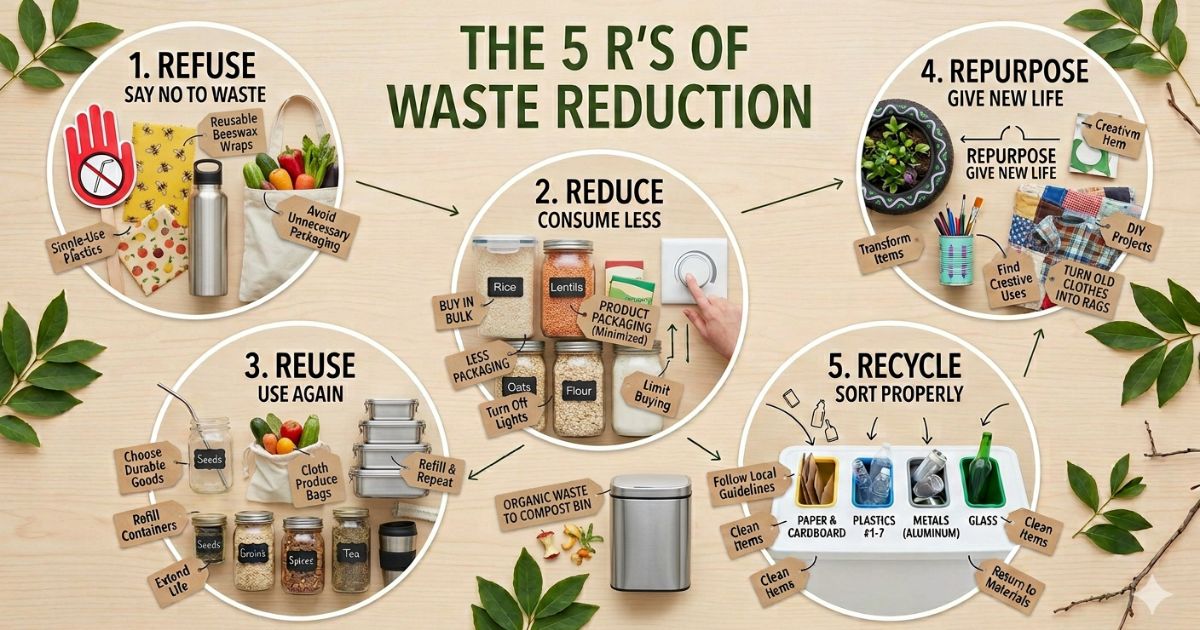
The kitchen produces most household trash in the U.S. Start here for maximum impact:
- Replace paper towels with washable cloths (old t-shirts work perfectly)
- Swap plastic wrap for beeswax wraps or silicone food covers
- Use glass food storage instead of plastic containers
- Buy dry goods in bulk when possible using your own containers
Retailers like Package Free Shop and EarthHero offer plastic-free essentials and refillable products shipped nationwide. They make sustainable shopping convenient regardless of where you live.
Composting is another high-impact move. Food waste makes up roughly 30% of what Americans throw away. Many cities now provide green bins or curbside compost programs.
If municipal composting isn’t available, consider:
- Backyard composting in a simple bin or tumbler
- Community garden drop-off programs
- Countertop compost systems for apartment living
The Bathroom – Hidden Plastic Hotspot
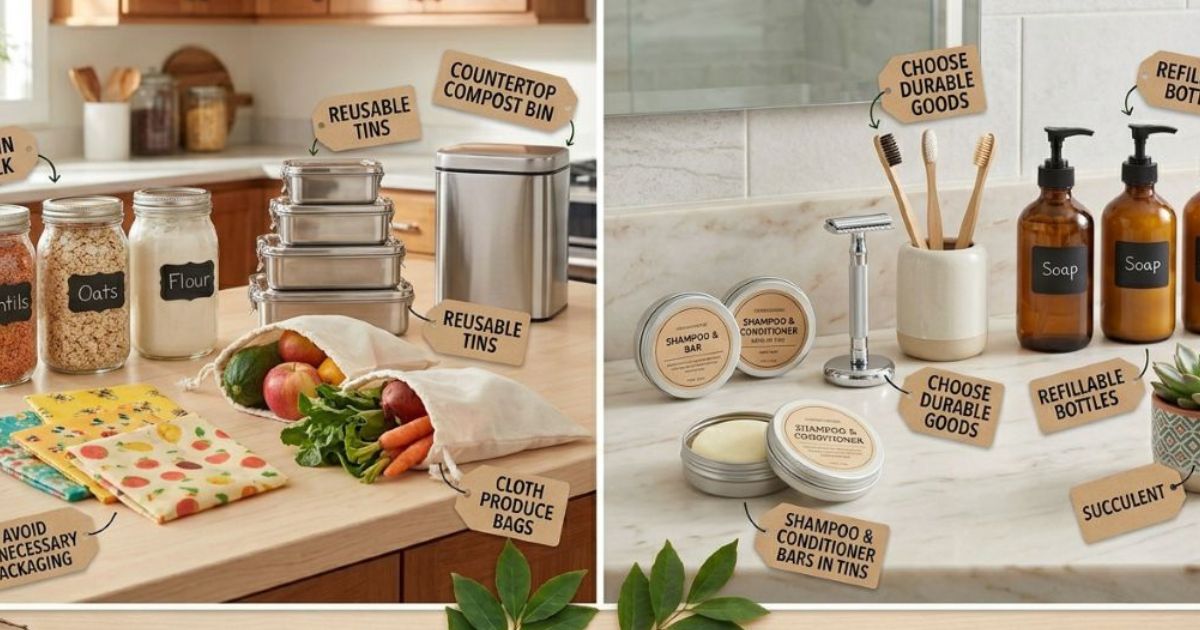
Bathrooms quietly generate enormous plastic waste. Easy swaps make a significant difference:
- Shampoo bars instead of bottled shampoo (each bar replaces 2-3 plastic bottles)
- Bar soap instead of liquid soap in plastic pumps
- Safety razors instead of disposable plastic razors (they last a lifetime)
- Bamboo toothbrushes instead of plastic (Americans discard billions annually)
Refillable deodorant systems and aluminum-free solid options are also widely available in 2027. Brands like Ethique and Leaf Shave lead the way in plastic-free personal care.
Financial and Personal Benefits
Zero waste living is often perceived as expensive. In reality, it can be financially empowering.
H3: Save Real Money
Upfront costs may be higher for durable goods. However:
- A safety razor costs more upfront but lasts decades
- Reusable bottles eliminate daily beverage purchases ($500+ annually)
- Cloth towels replace endless paper roll purchases ($80-100 yearly)
Over time, many families cut annual household costs by $500–1,200.
Reduce Clutter and Stress
Owning fewer disposable and impulse items reduces:
- Cleaning time significantly
- Storage needs throughout your home
- Decision fatigue from too many choices
Minimal consumption often leads to greater mental clarity and peace.
Improve Indoor Health
Reducing plastics helps limit exposure to chemicals such as BPA and phthalates, commonly found in disposable packaging. Less synthetic clutter often means cleaner air and surfaces in your home.
Strengthen Community Connections
Zero waste encourages:
- Local buy-nothing groups on Facebook
- Tool-sharing libraries in many cities
- Clothing swaps with friends and neighbors
- Community composting programs bringing people together
Sustainability builds connection—not isolation.
Staying Consistent Without Burnout
Perfection is unrealistic. Progress is powerful.
Aim to make better choices 80% of the time. When you forget your bags or accept a plastic straw, simply try again next time.
Practical motivation strategies:
- Track your trash for one week to identify patterns
- Set one monthly swap goal (January: reusable bags, February: shampoo bars)
- Join local sustainability groups on Facebook or Meetup
- Visit zero waste stores in person or online to stay inspired
When you see your trash shrink, momentum builds naturally.
Frequently Asked Questions for Americans
Is zero waste realistic in rural America?
Yes, absolutely. Even without bulk stores, you can:
- Choose larger cardboard packaging over small plastic containers
- Compost at home in a simple backyard bin
- Repair instead of replace clothing and electronics
- Shop secondhand at local thrift stores or online
Online retailers now offer plastic-free shipping across the entire U.S., making sustainable goods accessible everywhere.
What if my city doesn’t offer composting?
Backyard composting works in most American climates. Alternatively, some community gardens and farmers markets accept food scraps.
Even freezing scraps until drop-off day can make participation easier. Many Americans successfully compost without municipal programs.
Is recycling enough?
No. Recycling is helpful but limited. Many plastics are downcycled or exported overseas. The Environmental Protection Agency emphasizes that reducing and reusing have greater environmental impact than recycling alone.
How do I reduce waste while traveling?
Pack a small zero waste kit:
- Reusable water bottle (fill after security)
- Cloth tote bag for purchases
- Travel utensils (bamboo or stainless steel)
- Collapsible food container for leftovers
Preparation prevents most airport, restaurant, and hotel waste.
What about state recycling differences?
Recycling rules vary significantly by location. Check your city or county website for specific guidelines. When in doubt, visit Earth911.com and enter your zip code for localized recycling information.
Final Thoughts – Your Role in America’s Waste Future
Nearly every piece of plastic ever produced still exists in some form. The question is whether we continue adding to that pile.
Zero waste living in the United States in 2026–2027 is no longer a fringe movement. It is supported by:
- Policy shifts like EPR laws in California and Maine
- Growing consumer awareness across all demographics
- Expanding retail options from major brands
- Community infrastructure like composting and tool libraries
Start small.
Replace one disposable item this week. Compost one category of food waste. Refuse one unnecessary purchase.
When millions of Americans make small changes, industries respond. Markets shift. Policies advance.
Sustainability is not about perfection. It is about participation.
For more inspiration, revisit our Zero Waste Living Definition (2026 to 2027): Complete Beginner’s Guide to a Waste-Free Life whenever you need a refresher or motivation boost.
External Resource: For scientifically-validated guidance, explore the Environmental Protection Agency’s sustainable materials management resources.
Your journey starts today. Enjoy every penny saved and every piece of waste avoided